
Trees don’t send text messages and they don’t schedule appointments, leave voicemails, or knock on your front door when something is wrong. Instead, they communicate through their leaves, branches, bark, roots, and overall appearance. The challenge for homeowners is figuring out which changes are perfectly normal and which ones deserve a closer look.
A tree that suddenly drops leaves in July might be responding to environmental stress. A branch that has lost its leaves while the rest of the canopy remains green could indicate a localized problem. Even subtle changes in the color or texture of a tree’s bark may offer clues about its condition.
Recognizing these signals can help homeowners make informed decisions about their landscapes. Experienced Monmouth County tree companies, such as Ben Bivins Tree Experts, can help interpret these warning signs and determine whether a tree needs treatment, pruning, additional monitoring, or removal.
Here are some of the ways your trees might be telling you that something has changed.
1. “I’m Losing My Leaves, and It’s Not Even Fall!”
Leaves provide valuable information about a tree’s health, but their appearance must be considered alongside the season and the tree species.
During summer, premature leaf drop may occur when a tree experiences drought, excessive moisture, insect activity, or disease. Some trees respond to prolonged dry conditions by shedding part of their foliage to conserve water.
Yellowing leaves can also indicate environmental stress, nutrient imbalances, or problems affecting the root system.
However, not every unusual leaf is a reason for alarm. Some species naturally shed older foliage during the growing season, and certain trees are more sensitive to environmental changes than others.
Pay attention to the pattern. Are leaves falling throughout the canopy, or is the problem concentrated on one branch? Have several trees of the same species developed similar symptoms?
These observations can help a tree care professional narrow down potential causes.
2. “That Branch Hasn’t Looked Right in a While.”
A mature tree may develop dead branches while the rest of its canopy continues growing normally.
Deadwood can result from shading, disease, storm damage, insect activity, or natural changes as a tree matures. Regardless of the underlying cause, dead branches may eventually fall, creating potential hazards for people and property.
Homeowners should watch for branches that remain bare during the growing season, broken limbs hanging in the canopy, and sections of the tree that appear noticeably different from surrounding growth.
The position of the affected branch matters, too. A dead limb extending over a driveway, sidewalk, outdoor seating area, or roof may warrant more immediate attention than one located in an area with little activity.
Professional Monmouth County tree companies can evaluate deadwood and determine whether selective pruning would address the concern or whether additional structural problems require attention.
3. “Something Is Happening Beneath the Surface.”
A tree’s root system performs several essential functions. Roots absorb water and nutrients, help anchor the tree, and support the growth of the canopy above.
Unfortunately, homeowners cannot easily see most of the root system, which means problems may develop before obvious symptoms appear.
Construction activity, soil compaction, changes in drainage, and prolonged periods of saturated soil can all affect root function.
Consider a tree growing near a driveway that recently underwent major construction. Heavy equipment may have compacted the surrounding soil, reducing the space available for air and water to move through it. Excavation may also have damaged important roots.
The tree might continue looking healthy for some time before showing signs of stress.
Homeowners should also watch for newly exposed roots, changes in the surrounding soil, and noticeable movement of the root plate.
If a tree suddenly begins leaning or the ground around its base starts lifting, keep people away from the area and contact a qualified tree care professional promptly.
4. “My Bark Is Changing. Should You Be Concerned?”
Bark serves as a protective outer layer, helping shield a tree from environmental conditions and physical damage.
Its appearance varies considerably among species. Some trees have smooth bark, while others develop rough textures, deep ridges, or naturally peeling surfaces.
However, certain changes deserve attention.
Large areas of missing bark, unusual cracks, visible cavities, or fungal growth around the trunk may indicate an underlying problem.
Homeowners should be particularly observant after severe weather. A lightning strike, falling branch, or impact from equipment can damage the trunk and expose internal wood.
Not all bark changes indicate poor health. For example, exfoliating bark is a normal characteristic of several tree species.
The important distinction involves understanding what is typical for a particular tree and recognizing when its appearance changes unexpectedly.
Ben Bivins Tree Experts can help homeowners evaluate visible damage and determine whether corrective care or a more detailed assessment is appropriate.
5. “I’ve Been Leaning for Years, but Now Something Feels Different.”
Not every leaning tree presents an immediate danger.
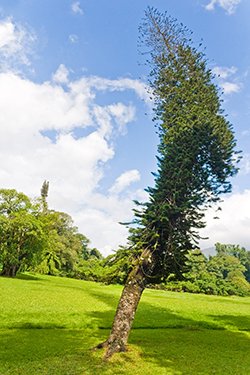
Some trees develop a natural lean as they grow toward available sunlight or adapt to surrounding conditions. A tree that has maintained the same position for decades may have developed a root system and structure that accommodate its growth pattern.
A sudden or increasing lean, however, deserves attention.
Changes in the angle of the trunk, newly exposed roots, or disturbed soil near the base may suggest that the tree’s stability has changed.
A professional assessment should consider the tree’s species, overall condition, root environment, and proximity to buildings or regularly occupied areas.
Among the services provided by Monmouth County tree companies, evaluating potentially hazardous trees is especially important after storms and periods of saturated soil.
Homeowners should avoid attempting to straighten a large leaning tree or cutting branches to compensate for an apparent imbalance. These actions can create additional hazards without addressing the underlying concern.
6. “My Neighbors Look Great, but I’m Struggling.”
Imagine three similar trees growing along the same property line. Two have full, healthy looking canopies, while the third has sparse foliage and several declining branches.
Why would one tree struggle when the others appear perfectly healthy?
The answer may involve differences that are not immediately visible.
Soil conditions can vary across a relatively small area. One tree might receive more water because of surrounding drainage patterns, while another could have roots extending beneath a paved surface.
Previous construction, mechanical injuries, localized insect activity, and differences in planting depth may also contribute to uneven growth.
Comparing nearby trees can provide useful clues, particularly when they belong to the same species and are approximately the same age.
However, appearances alone cannot establish a diagnosis. A professional evaluation can help identify the factors contributing to the difference.
A Tree’s History Matters Just as Much as Its Appearance
When contacting a tree care company, homeowners can provide valuable information by explaining how a tree has changed over time.
Was the property recently renovated? Did the tree suffer damage during a storm? Has the surrounding soil remained unusually wet? Did the symptoms appear suddenly, or have they developed gradually over several growing seasons?
Photographs can be particularly useful for documenting changes.
Taking pictures of the same tree at different points throughout the year creates a visual record that may help identify declining foliage, changing branch structure, or other developing conditions.
It is also helpful to document when symptoms first appeared and whether they seem to be spreading.
The more information a tree care professional has about the property’s history, the easier it may be to identify potential contributing factors and recommend appropriate next steps.
Let Monmouth County Tree Companies Help You Understand Your Trees
Trees are valuable features of residential and commercial landscapes throughout Monmouth County. Recognizing changes in their condition can help property owners address potential problems before they become more complicated.
However, the same visible symptom can have several possible causes. Yellowing leaves do not automatically indicate disease, and a bare branch does not necessarily mean an entire tree is declining.
That is why professional evaluation matters. Ben Bivins Tree Experts provides professional tree care services to homeowners and businesses throughout Monmouth County and surrounding New Jersey communities.
Whether you have concerns about a tree’s condition, need professional pruning, or require tree removal, their team can help you determine the appropriate course of action.
When comparing Monmouth County tree companies, look for a provider that takes the time to understand your property’s specific needs rather than recommending the same solution for every situation.
Contact Ben Bivins Tree Experts to discuss your tree care concerns and schedule professional service.
Your trees may not be able to tell you exactly what is wrong, but their appearance can provide important clues. Paying attention to those changes is a good place to start.